
First of all, here's what we have for you this week:
- Killer Grabs: Liberal leadership speculation gives us the goods, yet again.
- How The Media Forgot How To Cover One Nation Properly — By Scott Mitchell
- The Good Ones: Movies, books, TV, we've got it all this week!
 Scott Mitchell
On this Thursday's episode of the podcast, there was so much Australian media nonsense to wade through we didn't have time to talk about one of the biggest stories in the world right now: the multiple deaths of innocent citizens in Minnesota at the hands of US ICE (Immigration and Customs Enforcement) officers, and the ensuing mass protests.
The way the Australian government and legacy media outlets have continued to treat the Trump regime as a "normal" government, despite its increasingly rapid descent into authorianism and outright fascism, is something we've picked apart a number of times over the past year.
Even though Trump's racist attacks on migrant groups, his illegal bombing campaigns, his stacking of formerly independent public institutions and his attempt to enforce a new international political orthodoxy (like his "Board of Peace") have been very clear warning signs for a while, sometimes it takes something more tangible, and closer to home, for reality to hit home.
The killings of Renee Good and Alex Pretti appear to be that crystallising moment for millions of Americans. The public response against those shootings feels like the biggest and sharpest reaction to Trumpism 2.0 we've seen yet. It was so immediate, forceful and widespread, that it appears to have forced Trump to drastically shift tack and wind back his attempt to flood Minnesota with ICE agents.
And while many political and cultural figures have been less willing to openly criticise Trump during his second presidency, out of fear of drawing ire from the MAGA moment that has swept through not just political institutions but media and entertainment ones as well, over the past few days more people have vocally expressed opposition to Trump than at anytime over the past 12 months. The New York Times has declared America is at a "boiling point".
While Trump appears to be walking back his war on Minnesota, it remains unclear how sustained or effective this newly galvanised pushback will be. The only thing that is certain is what we are seeing in the US is a warning of things to come across the world, as far-right authoritarianism continues its march.
The seeming unwillingness in mainstream Australian politics and media to take a stand against Trump and forces aligned to him should make everyone in this country extremely nervous. It was only a few months ago that Pauline Hanson, escorted by Gina Rinehart, spoke at a global right-wing convention at Mar-a-Lago.
Now her party is polling record high numbers and showing no signs of slowing. Australia is far from immune from the scenes we are seeing in the US. The one advantage we have is being able to see what's coming from us, and responding accordingly.
That's something our biggest media outlets seem steadfastly committed to not doing, as Scott breaks down in this week's article.
Killer Grabs
"Mr Hastie, whose wife was quoted in The Australian last weekend blessing his leadership tilt..." — Clare Armstrong, ABC chief digital political correspondent.
As listeners of the podcast will know, Andrew Hastie's wife was definitely not quoted in as blessing his leadership tilt. A "source close to" Hastie was quoted as saying that.
Why that actually matters, or whether it's a surprise, is a different question. Why it's being quoted by the ABC in a different story four days later is another, more confusing, question.
"Imagine you live with Sussan Ley and she arrives home from work after badly damaging the family car, a government-financed white BMW." — Aaron Patrick, correspondent for The Nightly.
The only thing worse than this tortured metaphor is the headline this story ran under. Ready? "Why I wouldn't marry Sussan Ley".
Cool story bro. Is it just us, or is this particular leadership battle... more stupid than usual?
"The numbers are reliable and [the Israeli military] now regularly uses them internally in intelligence briefings." — An investigation into the accuracy of Gaza health ministry statistics, published two years ago.
Overnight, the Israeli government admitted that the data from Gaza's health ministry of over 70,000 dead is accurate.
It comes after years of Israeli spokespeople and lobbyists belligerently attacking anyone who quoted Gaza health ministry data, bullying news organisations into enforcing policies like always reminding readers that it was the "Hamas-run" health ministry, to cast doubt on the numbers.
Not only was the data right all along, but news organisations went along with it, even though everyone had enough evidence that it was accurate years ago. We look forward to the apologies and retractions from Australian news editors.
How The Media Forgot How To Cover One Nation Properly
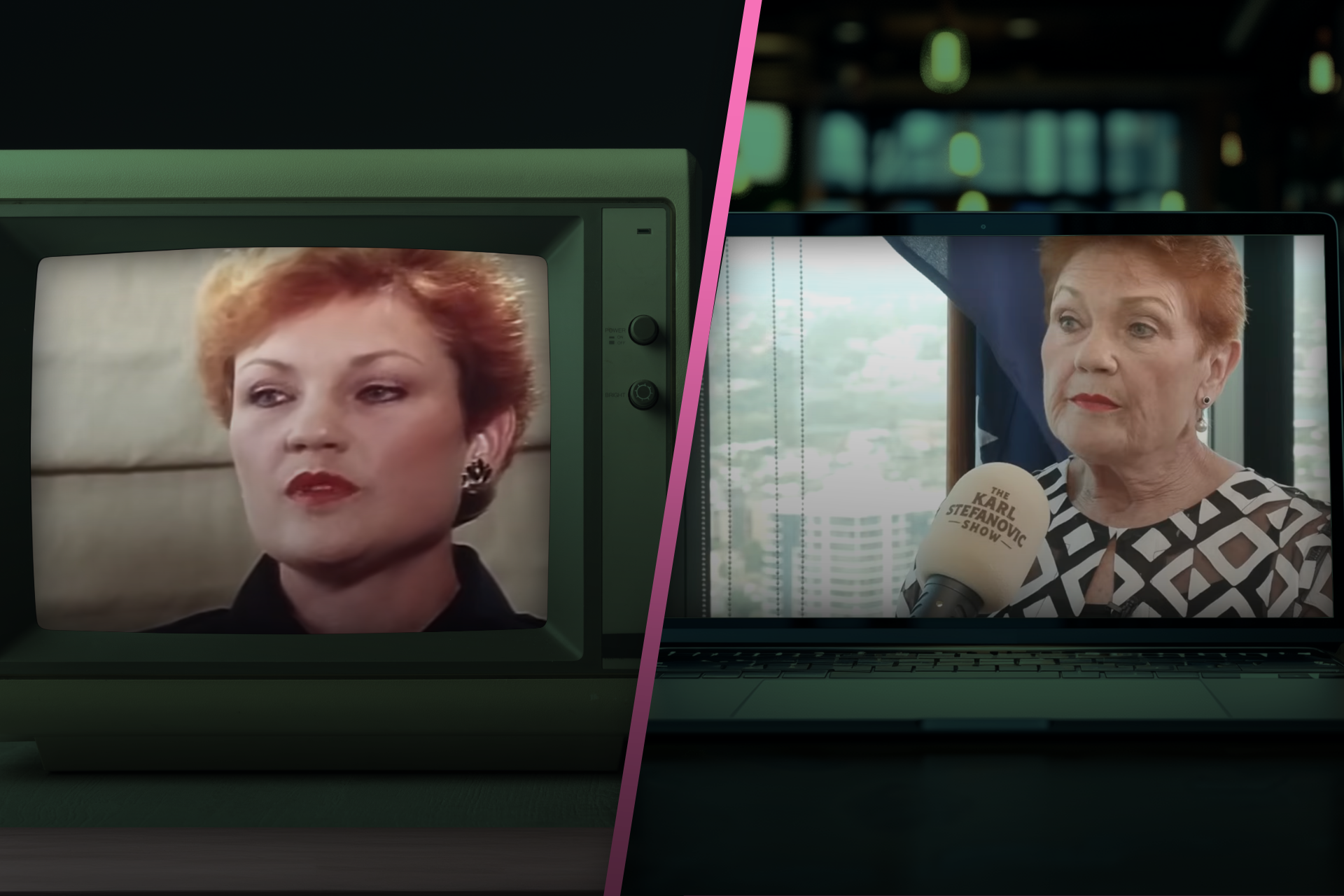
Three decades ago, Pauline Hanson’s brand of politics was so shocking, aberrant and dangerous that it made the front page of The Washington Post.
The year was 1998 and the Post was still an American newspaper of record. Hanson’s photo was worth printing on the front page, because something momentous had happened: after being discounted by most of the Australian media, One Nation had reached its highest ever polling at the time. The paper described her and her party as “ultranationalist”.
The term sticks out because today, no major media organisation uses labels like “ultranationalist” or even “far-right” to describe One Nation’s politics.